
Your Quick Guide to Local Rules and Permit Costs
July 10, 2025
Picture this: You’ve just bought your dream home in Marin County. It’s peaceful, green, and exactly what you envisioned, except for one overgrown tree threatening your roofline. Before calling in a crew, you pause. Do you need a permit? Can you remove it without getting fined? You’re not alone. Figuring out which tree laws apply in Marin County isn’t always straightforward. That’s why we’ve laid it all out in plain, easy-to-follow steps. No guessing, no confusion, just what you need to know to move forward confidently.
If you’re getting ready to clean up your yard, deal with a risky tree, or plan a backyard upgrade, it pays to check the local rules first. A little clarity now can save you a lot of trouble later. You shouldn’t have to dig through multiple websites to find the facts we’ve got you covered here.
Let’s break it all down, with every detail you actually need in one place.
How to Know if Your Tree is Regulated
This is where most homeowners get stuck. It’s not always obvious. Here’s how to check.
Checklist:
- Is the tree near a slope or on a scenic easement?
- Does it fall under your city’s “landmark” or “heritage” list?
- Is it over 10 inches in diameter measured 4.5 feet from the ground?
- Is it a native California species?
If you answered yes to any, assume it’s regulated until proven otherwise. It’s easier to pause and verify than face removal penalties.
What Counts as a Protected Tree in Marin County?
Protected trees aren’t always large or old. Many are listed under local ordinances based on species, location, or trunk size.
Examples include:
- Native trees like Coast Live Oak or California Bay
- Any tree over a certain trunk diameter (often 10 inches or more)
- Trees in designated scenic corridors or open space zones
Did You Know? Some trees are protected regardless of size, simply because of their ecological value or impact on the landscape.
Understanding this distinction helps you avoid unintentional violations. It’s not just about height or how close it leans. It’s about what that tree means to the environment.
Who Decides: City vs County Authority
This is a frequent stumbling block.
- If you live within city limits, city rules apply.
- If your property is in an unincorporated area, the county takes charge.
To confirm, check Marin County’s GIS map or call your city clerk’s office.
Tree Ordinance Rules by City in Marin
Every city sets its own tree rules. That’s where most confusion starts. A tree you can remove in Novato might require three forms and an arborist report in Mill Valley.
Examples:
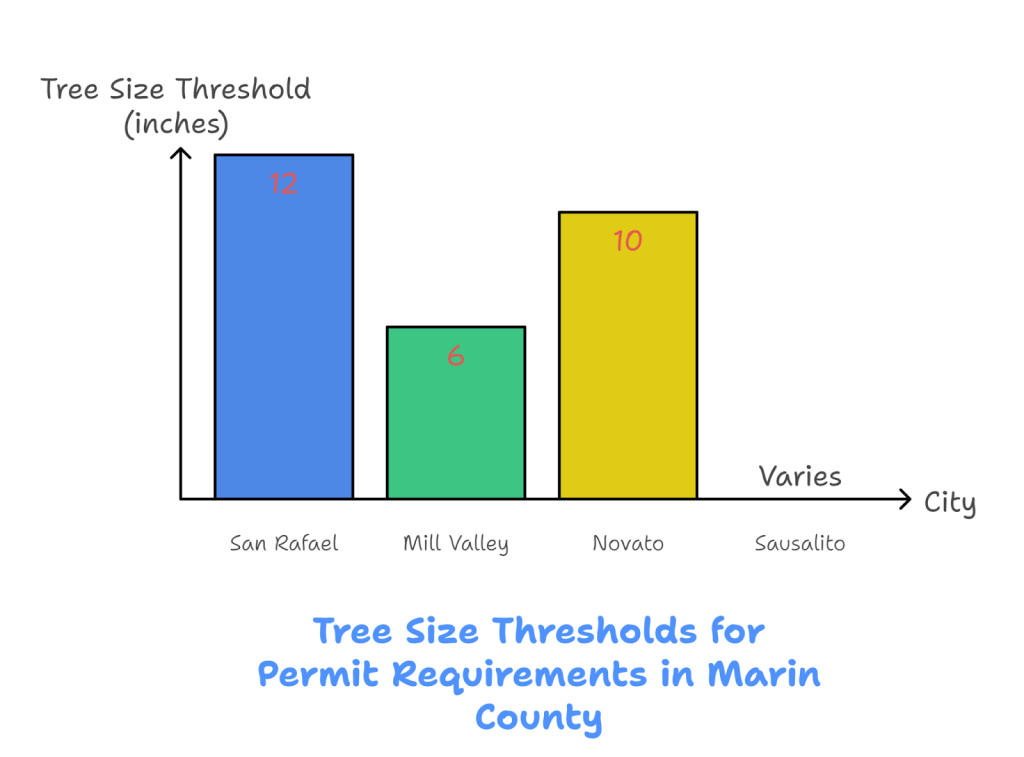
- San Rafael: Permits required for trees over 12 inches or protected species
- Mill Valley: Strict on oaks, madrones, bays, almost always needs arborist review
- Novato: Some flexibility for smaller, non-native trees
- Sausalito: Often protects trees in public view corridors, even if they’re on private property
- Sample Permit Thresholds by City
| City | Size Threshold | Native Protection | Arborist Report Required |
| San Rafael | 12+ inches | Yes | Often |
| Mill Valley | 6+ inches | Yes | Yes |
| Novato | 10+ inches | Sometimes | Case-by-case |
| Sausalito | Varies | Yes | Yes |
Do You Always Need a Tree Removal Permit?
Not always, but don’t assume you’re off the hook.
Permits are typically required when removing:
- Trees above the size threshold
- Trees within specific zoning districts (like Hillside or Historic zones)
- Street trees planted along sidewalks or public easements
If your tree is clearly dead or hazardous, some cities allow removal without permits. But documentation matters. A photo, arborist note, or city inspection can keep you protected.
Pro Tip: Even if your neighbor got approval, that doesn’t mean your situation qualifies. Every address, species, and lot is different.
When You Can Remove a Tree Without a Permit
Yes, it’s possible. But there are limits.
You can usually remove a tree without a permit if:
- A certified arborist declares it unsafe or beyond recovery
- It poses an immediate safety risk (like it’s leaning toward your home after a storm)
- It’s already dead or severely diseased
- It’s a non-native, invasive species (varies by city)
Get documentation. Even a simple email or report can make all the difference later if questioned.
What to Include in Your Arborist Report
Think of this report as your legal protection and your permit’s backbone. If it’s weak, your application may get denied.
A strong report includes:
- Clear species identification (common and botanical names)
- Tree health condition with signs of disease, decay, or infestation
- Risk assessment (likelihood of failure, proximity to structures)
- Photos, preferably with visual indicators or measurements
- Justification for removal instead of alternative care
Some cities request extra detail, like root structure notes or soil condition. The more thorough your report, the smoother your permit path.
How the Tree Permit Process Works Step by Step
- Look up your city’s tree ordinance. These are usually on the official planning or public works websites.
- Hire an ISA-certified arborist. This isn’t just a formality. Their input is crucial.
- Prepare your application. This includes basic details, your reason for removal, and site drawings or maps.
- Attach the arborist report. Ensure it’s recent, ideally within the last 30 days.
- Submit and monitor. Some cities give you a portal, others require in-person submission.
- Respond if needed. Planners might request clarification or an additional report.
Emergency cases may be fast-tracked. But standard reviews can take several weeks, depending on your city.
What Happens if You Remove a Tree Without a Permit?
The consequences aren’t just financial.
- Fines (amount depends on city rules and severity)
- Required replanting, often 1-to-1 or more
- Development holds, especially if tied to larger construction work
- Enforcement investigations which can trigger hearings
It’s not worth the risk.
Understanding Heritage Trees vs. Street Trees
This causes a lot of mix-ups. A heritage tree is one that stands out, maybe because it’s unusually large, very old, or part of your city’s history. These trees get special protection for a reason. These trees are given extra protection for good reason. You’ll often find these notes in city records.
Street Trees sit on or near public sidewalks. They may be on your property line, but are governed by city ordinances. Trimming or removing these almost always requires pre-approval.
Understanding this distinction can save you from a costly misunderstanding.
Common Mistakes Homeowners Make
- Assuming city and county rules are the same
- Letting contractors decide permit needs instead of checking for yourself
- Thinking dead or diseased means free pass, you still need documentation
- Ignoring tree removal ordinances during renovations
We’ve seen it happen: a homeowner takes out a tree before building a deck and ends up stuck in an appeal process that delays the whole project.
How to Appeal a Denied Tree Removal Permit
If your permit is denied, you’re not stuck.
Here’s what to do:
- Review the decision notice carefully. See why it was denied.
- Fix the issue. That may mean submitting a new arborist report or proposing alternatives.
- File your appeal. Usually through the planning department or a city hearing board.
- Prepare for a hearing. You might need to explain your case live, with evidence.
Most appeals succeed if the request is reasonable and backed with solid evidence.
What If You Want to Replace the Tree?
Good news: Most cities welcome thoughtful replanting and even encourage native replacements.
Things to consider:
- Species selection matters. Native trees like coast oaks or maples are often preferred.
- Placement must follow city setback rules.
- Some cities require the replacement tree to be maintained for 3 to 5 years post-planting.
Check your city’s approved tree list. That way, you won’t plant something that needs to be removed again later.
Tree Trouble You Didn’t Know to Watch Out For
Every city has fine print, but some surprises are uniquely Marin. For example, trees bordering creeks or trails often fall under separate environmental review. If you’re near a habitat corridor or slope, your tree might be subject to rules you didn’t know existed.
Another issue is neighbor disputes. Tree branches that cross fences, block views, or drop debris can stir up legal battles. Even with permits, you may need a civil agreement to avoid backlash.
Knowing these before you act can save a lot of stress and lawyer fees.
The One Step Most People Forget
You’ve got the arborist. The application’s in. The city says go ahead. But don’t forget utility clearance. Before any tree work starts, call 811 or your local utility locate service. Trees near power lines, gas lines, or underground cables need pre-marking, even if the tree is on your property. Skipping this step is not just dangerous. It can delay your removal and cause fines. Taking this extra moment adds a layer of safety and keeps your project on track.
Reader Questions, Answered
Can I remove a tree without a permit in Marin?
Yes, but only in very specific cases, like dead trees or serious hazard trees. You’ll usually need proof.
How do I know if my tree is protected?
Check the size, species, and location. Your city or county website will have lists and thresholds.
Who oversees tree permits outside of city boundaries?
The Marin County Planning Division.
How long does approval take?
Anywhere from 2 days (emergency) to 4 or more weeks (standard cases).
Is trimming allowed without permits?
Light pruning is often fine. But large cuts, crown reduction, or root pruning might need review.
What if someone removes a tree illegally?
Report it to code enforcement. There may be investigations and mandatory replanting.
Final Thoughts
Marin County doesn’t just protect trees. It protects the balance between people and nature. These laws aren’t about red tape. They’re about safety, landscape preservation, and keeping your neighborhood beautiful.
Still thinking it over? Got questions? We’re here when you need us and we’ll walk you through it, step by step. Find out more on our tree services in Marin County.